
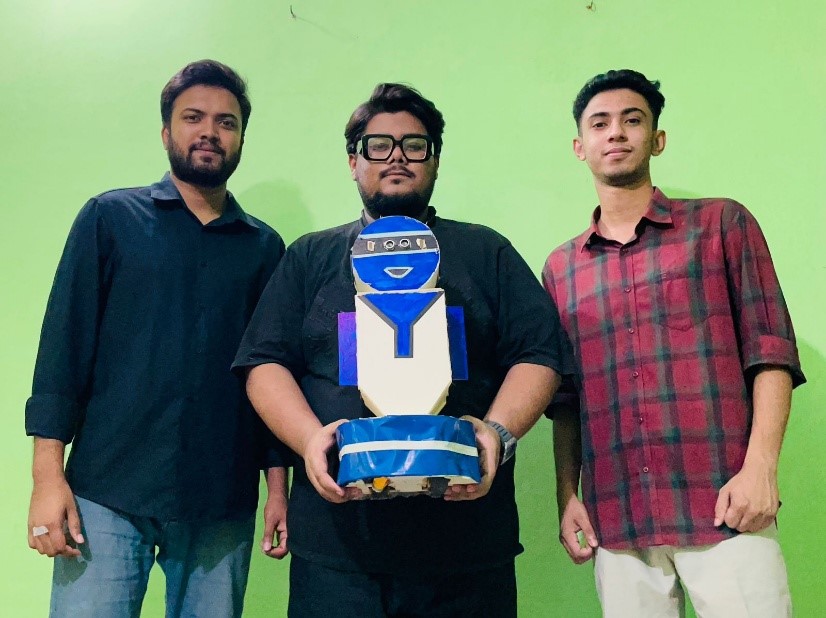
Students, guided by the mentorship of their professors, apply knowledge gained from their core Computer Science and Communication Engineering courses to design and build innovative robotic systems. They have demonstrated exceptional capability and efficiency, engaging in research and project-based work aligned with global, first-world standards.
The Shadow Bot project exemplifies this excellence. It aims to design and develop a voice-controlled robot powered by a Raspberry Pi single-board computer. The primary objective is to create a system that can understand spoken commands via a microphone, process those commands intelligently, and respond either through audible replies or by controlling hardware components such as motors or LEDs.
The project involves developing a robust audio capture system on the Raspberry Pi using a standard microphone and integrating Speech-to-Text (STT) capabilities to accurately convert spoken language into processable text data. Both online and offline STT solutions are explored. Command parsing logic is implemented to analyze transcribed text and determine the user’s intended action. Additionally, Text-to-Speech (TTS) functionality is incorporated to generate natural audible responses, with both online and offline options considered.
To enhance interactivity, optional GPIO control enables the robot to physically respond to commands—such as movement through motors or visual signaling via LEDs. A wake word detection mechanism can also be implemented for hands-free activation of the listening mode. The project delivers functional source code and documentation, showcasing the students’ ability to integrate hardware, software, and AI into a seamless, intelligent system.