




Version 2 Vs Version 3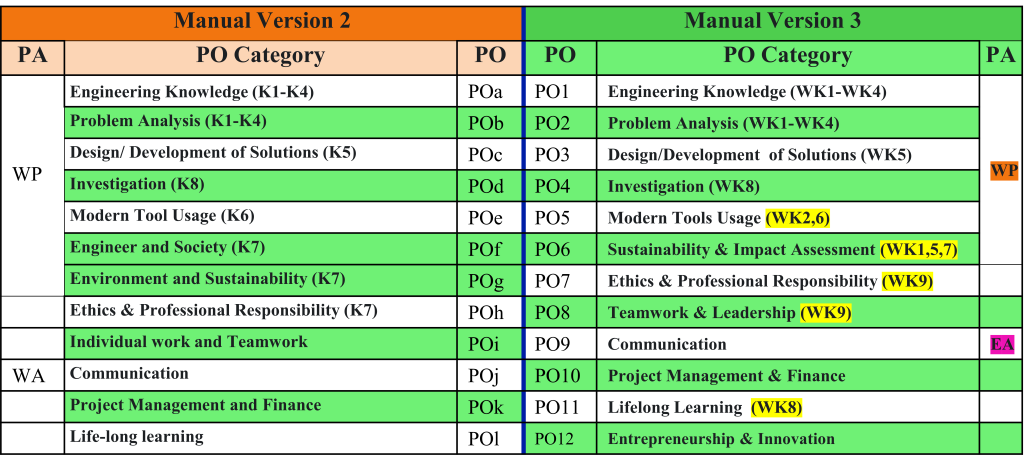
Program Outcome (POs)
| Program Outcome | Description |
|---|---|
| PO1 | Apply knowledge of mathematics, natural science, computing, engineering fundamentals and an engineering specialization as specified in WK1 to WK4 respectively to develop solutions of complex engineering problems. |
| PO2 | Identify, formulate, research literature and analyze complex engineering problems reaching substantiated conclusions using first principles of mathematics, natural sciences and engineering sciences with holistic considerations for sustainable development (WK1 to WK4). |
| PO3 | Design creative solutions for complex engineering problems and design systems, components or processes to meet identified needs with appropriate consideration for public health and safety, whole-life cost, net zero carbon as well as resource, cultural, societal, and environmental considerations as required (WK5). |
| PO4 | Conduct investigations of complex engineering problems using research methods including research-based knowledge, design of experiments, analysis and interpretation of data, and synthesis of information to provide valid conclusions (WK8). |
| PO5 | Create, select and apply and recognize limitations of appropriate techniques, resources, and modern engineering and IT tools, including prediction and modeling, to complex engineering problems (WK2, WK6). |
| PO6 | When solving complex engineering problems, analyze and evaluate sustainable development impacts to: society, the economy, sustainability, health and safety, legal frameworks, and the environment (WK1, WK5, and WK7). |
| PO7 | Apply ethical principles and commit to professional ethics and norms of engineering practice and adhere to relevant national and international laws. Demonstrate an understanding of the need for diversity and inclusion (WK9). |
| PO8 | Function effectively as an individual, and as a member or leader in diverse and inclusive teams and in multi-disciplinary, face-to-face, remote and distributed settings (WK9). |
| PO9 | Communicate effectively and inclusively on complex engineering activities with the engineering community and with society at large, such as being able to comprehend and write effective reports and design documentation, make effective presentations, taking into account cultural, language, and learning differences. |
| PO10 | Apply knowledge and understanding of engineering management principles and economic decision-making and apply these to one’s own work, as a member and leader in a team and to manage projects and in multidisciplinary environments. |
| PO11 | Recognize the need for, and have the preparation and ability for i) independent and life-long learning ii) adaptability to new and emerging technologies and iii) critical thinking in the broadest context of technological change (WK8). |
| PO12 | Demonstrate knowledge and understanding of the competences necessary to transform opportunities and ideas into a new business. |
Knowledge and attitude Profile
| WK | Attribute |
| WK1 | A systematic, theory-based understanding of the natural sciences applicable to the discipline and awareness of relevant social sciences |
| WK2 | Conceptually based mathematics, numerical analysis, data analysis, statistics and the formal aspects of computer and information science to support detailed analysis and modeling applicable to the discipline |
| WK3 | A systematic, theory-based formulation of engineering fundamentals required in the engineering discipline |
| WK4 | Engineering specialist knowledge that provides theoretical frameworks and bodies of knowledge for the accepted practice areas in the engineering discipline; much is at the forefront of the discipline |
| WK5 | Knowledge, including efficient resource use, environmental impacts, whole-life cost, re-use of resources, net zero carbon, and similar concepts, that supports engineering design and operations in a practice area |
| WK6 | Knowledge of engineering practice (technology) in the practice areas in the engineering discipline |
| WK7 | Knowledge of the role of engineering in society and identified issues in engineering practice in the discipline, such as professional responsibility of an engineer to public safety and sustainable development |
| WK8 | Engagement with selected knowledge in the current research literature of the discipline, awareness of the power of critical thinking and creative approaches to evaluate emerging issues |
| WK9 | Ethics, inclusive behavior and conduct. Knowledge of professional ethics, responsibilities, and norms of engineering practice. Awareness of the need for diversity by reason of ethnicity, gender, age, physical ability etc. with mutual understanding and respect, and of inclusive attitudes |
Range of Complex Engineering Problem Solving
| WP | Attribute | Complex Engineering Problems have characteristics WP1 and some or all of WP2 to WP7: |
| WP1 | Depth of knowledge required | Cannot be resolved without in-depth engineering knowledge at the level of one or more of WK3, WK4, WK5, WK6 or WK8 which allows a fundamentals-based, first principles analytical approach |
| WP2 | Range of conflicting requirements | Involve wide-ranging or conflicting technical, non-technical issues (such as ethical, sustainability, legal, political, economic, societal) and consideration of future requirements |
| WP3 | Depth of analysis required | Have no obvious solution and require abstract thinking, creativity and originality in analysis to formulate suitable models |
| WP4 | Familiarity of issues | Involve infrequently encountered issues or novel problems |
| WP5 | Extent of applicable codes | Address problems not encompassed by standards and codes of practice for professional engineering |
| WP6 | Extent of stakeholder involvement and conflicting requirements | Involve collaboration across engineering disciplines, other fields, and/or diverse groups of stakeholders with widely varying needs |
| WP7 | Interdependence | Address high level problems including many components or sub-problems that may require a systems approach |
Range of Complex Engineering Activities
| EA | Attribute | Complex activities mean (engineering) activities or projects that have some or all of the following characteristics: |
| EA1 | Range of resources | EA1: Involve the use of diverse resources including people, data and information, natural, financial and physical resources and appropriate technologies including analytical and/or design software |
| EA2 | Level of interactions | EA2: Require optimal resolution of interactions between wide-ranging and/or conflicting technical, non-technical, and engineering issues |
| EA3 | Innovation | EA3: Involve creative use of engineering principles, innovative solutions for a conscious purpose, and research-based knowledge |
| EA4 | Consequences to society and the environment | EA4: Have significant consequences in a range of contexts, characterized by difficulty of prediction and mitigation |
| EA5 | Familiarity | EA5: Can extend beyond previous experiences by applying principles-based approaches |